You sit there late one evening and look at your account. Three months ago it was full steam ahead. Customers were calling, invoices were being sent, everything felt like it had finally loosened up. Now it’s quiet. The calendar is empty. And somewhere in the back of your mind there’s that nagging thought that maybe you were lucky rather than skilled.
So you do the only reasonable thing. You roll up your sleeves and start chasing customers again. Calls, meetings, pitches. And suddenly it happens. Assignments come rolling in. You exhale, throw yourself into the delivery and think that now things are stable.
Until a few months later you sit there again and wonder what happened.
It looks like coincidence. It feels like bad luck. But it rarely is.
It’s not chaos. It’s a system
The classic explanation is simple. When you have time, you sell. When you have customers, you deliver. When you deliver, you don’t have time to sell. When you don’t sell, the influx of customers decreases. And when the customers decrease, you get time again.
It’s a self-reinforcing pattern. A kind of rhythm that arises from how you work rather than what you work with.
But this is just the beginning.
Because what looks like a personal weakness is often a systemic problem. And this is where it gets interesting.
The capacity trap that few people talk about
Many startups build their business around their own capacity. You are the product. Your time is the deal.
It works until it works too well.
When demand increases, you quickly reach the ceiling. You can’t deliver more without working more. And when you work more, there is even less room to think, sell or develop.
This creates a strange paradox. The better you go, the less equipped you become for the next step.
It’s like running a race where the faster you run, the more weight you get on your back.
The psychology behind the fluctuations
It’s easy to think that this is all about structure and planning. But a lot is in your head.
When things are going well, we relax. We think we’ve cracked the code. We start prioritizing delivery over the future. It feels rational. The customers are here.
When things are going badly, the opposite happens. Panic sets in. We get creative, hungry, and focused on creating new opportunities.
It’s almost ironic. We do our best work when we least want to be there.
This creates an emotional cycle that reinforces the operational one. Ups lead to comfort. Downs lead to activity.
Cash flow that controls more than you think
Another underestimated factor is cash flow. Not just how much money you make, but when it comes in.
Many startups work with delays. You deliver today, but get paid in thirty or sixty days. In the meantime, salaries, tools, and expenses have to be paid.
This creates a gap between reality and experience. You can be very busy and still feel financially stressed. Or have an empty calendar and still have money in your account.
This makes decision-making more difficult. Should you invest, save or gamble? The time lag means that you are always a little off in your feelings.
The hidden dynamics of the business model
All business models have an inherent rhythm. Some are stable, others are pulsating.
Consultancies are often pulsating. Projects come and go. Revenue follows the work.
Product-based companies can be more scalable, but often require upfront investment. You build something before you know if anyone wants to buy it.
Subscription models can create stability over time, but take time to build.
The problem arises when you don’t understand the rhythm you are playing in. You try to make a project-based business behave like a subscription service, or vice versa.
It’s like getting frustrated by the waves coming and going, instead of learning how to surf.
When systems meet reality
Add another dimension. Your customers also have their cycles. Budgets, decisions, seasons. You are affected by their reality, which in turn is affected by someone else’s.
Suddenly you are part of a larger system where the fluctuations are not just your own.
That’s why some periods feel inexplicably heavy. It’s not always you who did something wrong. Sometimes it’s the system that moves.
The entrepreneur who must stand still
This is where perhaps the most important insight comes in. These fluctuations do not disappear completely. They can be mitigated, understood and managed, but they are part of the game.
That’s why not everyone can do it.
It takes mental stamina to stand still when things fluctuate. To not overinterpret ups and downs as genius or downs as failure. To see patterns instead of reacting to every data point.
It’s less like driving a car and more like sailing. You can’t control the wind, but you can learn to read it.
Creating stability through synergies
But that doesn’t mean you’re powerless. There are ways to design your business so that the fluctuations are less brutal.
A powerful strategy is to combine different revenue logics. For example, combining services with products.
Services often provide faster cash flow but are difficult to scale. Products require more initial investment but can be sold over and over again.
By combining these, you can create a balance. Services finance the development of products. Products create long-term stability.
A concrete example is a consultant who starts packaging his experiences in digital courses or tools. When consulting assignments decrease, there is still a product that generates revenue.
When waste becomes a business
Another type of synergy is about seeing what is currently a side effect as an opportunity.
Imagine a company that produces something and has waste or residual products. Instead of seeing it as a cost, it can become a new product.
In food, we see this clearly. By-products from production become ingredients in other products. In industry, residual heat can be used in other processes.
It’s about thinking in systems rather than in lines. Seeing how flows are connected.
Designing for different tempos
Another way is to consciously build different tempos into the business.
Fast revenues that cover short-term needs. Slower initiatives that build the future. Experiments that could be the next big thing.
It creates a portfolio rather than a single track. And it makes you less vulnerable to individual fluctuations.
Creativity as a stabilizing force
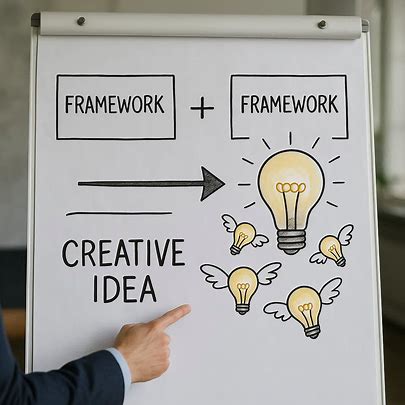
Perhaps the most unexpected thing is that creativity is not just about creating something new, but also about creating stability.
By thinking new about business models, offers and collaborations, you can find solutions that break patterns.
It can be about collaborating with others to share risk, repackaging offers or finding completely new customer groups.
Creativity then becomes not a luxury, but a way to survive.
The entrepreneur’s new language
Perhaps the most important thing is to stop chasing a perfectly smooth curve. Startups don’t live like that. They breathe. They move. They fluctuate. The question is not how to avoid the fluctuations, but how to build something that can handle them. And maybe, once you see the pattern, you realize that what felt like chaos was actually a language.
A language that tells you how your business works. And what it needs to be.